
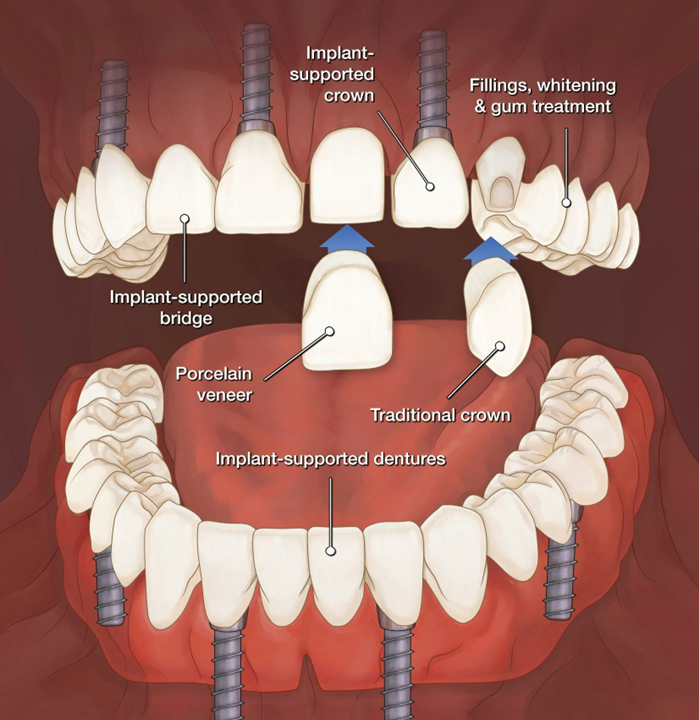
Modern dentistry has made it possible to completely restore a damaged smile—both functionally and aesthetically—through a treatment known as Full Mouth Rehabilitation. For patients with extensive dental issues, this comprehensive approach can dramatically improve oral health, comfort, and confidence.
In this detailed guide, we explain what full mouth rehabilitation is, who needs it, the step-by-step procedure, and the crucial role of Digital Smile Designing (DSD) in achieving predictable, beautiful results.
What Is Full Mouth Rehabilitation?
Full Mouth Rehabilitation, also known as full mouth reconstruction or full mouth restoration, is a customized dental treatment plan that rebuilds or replaces all the teeth in the upper and/or lower jaws. The goal is to restore function, aesthetics, and oral health simultaneously.
Unlike a single dental procedure, full mouth rehabilitation combines multiple dental specialties such as:
- Prosthodontics
- Restorative dentistry
- Periodontics
- Orthodontics
- Implant dentistry
- Cosmetic dentistry
Each treatment plan is unique and tailored to the patient’s dental condition and smile goals.
Who Needs Full Mouth Rehabilitation?
Full mouth rehabilitation is recommended for patients with severe or complex dental problems.
Common Indications Include:
- Multiple missing teeth
- Severely worn or broken teeth
- Advanced gum disease
- Chronic jaw pain or bite problems
- Failed dental restorations
- Trauma or accident-related tooth loss
- Congenital dental defects
Patients who struggle with chewing, speaking, or smiling confidently often benefit the most from full mouth rehabilitation.
Benefits of Full Mouth Rehabilitation
Full mouth rehabilitation goes beyond aesthetics—it restores overall oral function and quality of life.
Key Benefits:
- Improved chewing and digestion
- Balanced bite and jaw alignment
- Enhanced facial aesthetics
- Long-lasting dental stability
- Reduced pain and discomfort
- Boosted self-confidence
When planned correctly, the results are both functional and visually natural.
Step-by-Step Procedure for Full Mouth Rehabilitation
Full mouth rehabilitation follows a structured, carefully planned process. Each step builds on the previous one to ensure predictable and lasting outcomes.
Step 1: Comprehensive Consultation and Evaluation
The process begins with a detailed dental consultation.
What This Includes:
- Complete dental and medical history review
- Clinical examination of teeth, gums, and jaw joints
- Assessment of bite alignment and facial symmetry
- Discussion of patient concerns and expectations
- Impressions or Preoperative dental scan
This step establishes a clear understanding of the patient’s needs and goals.
Step 2: Deprogrammer
A deprogrammer is given to the patient that relaxes the muscles and breaks the muscle memory loop allowing the dentist to reposition your jaws in correct position and record what is called as the centric relation or your upper jaw to lower jaw relation
Step 3: Diagnostic Records and Imaging
Accurate diagnosis is critical for successful full mouth rehabilitation.
Diagnostic Tools Used:
- Digital X-rays
- CBCT (3D imaging) if implants are planned
- Intraoral and extraoral photographs
- Digital impressions or scans
- Bite analysis
- Centric Relation record
- Facebow transfer
These records provide precise data for treatment planning after deprogramming is done.
Step 4: Digital Smile Designing (DSD) – Planning the Perfect Smile
Digital Smile Designing (DSD) plays a transformative role in full mouth rehabilitation.
What Is Digital Smile Designing?
Digital Smile Designing is advanced software-based technology that allows dentists to digitally design and simulate a patient’s future smile before treatment begins.
Role of Digital Smile Designing in Full Mouth Rehabilitation
Digital Smile Designing bridges the gap between function and aesthetics.
Key Roles of DSD:
1. Smile Visualization
Patients can see a preview of their final smile, increasing confidence and trust in the treatment plan.
2. Precise Treatment Planning
DSD helps determine:
- Ideal tooth size and shape
- Proper tooth alignment
- Smile symmetry
- Facial harmony
3. Improved Communication
Dentists, specialists, and dental labs can collaborate more accurately using digital designs.
4. Predictable Results
DSD minimizes guesswork and enhances treatment accuracy.
5. Patient Involvement
Patients actively participate in smile design decisions, ensuring satisfaction.
Digital Smile Designing transforms full mouth rehabilitation into a patient-centered, precision-driven process. Using the DSD data and the records obtained after deprogramming a mock up is prepared which is transferred into the patient’s mouth using a process called “test-drive” to show the patient post operative results even before starting the treatment. Once the patient approves it then the treatment is started.
Step 5: Phased Treatment Planning
After DSD approval, a step-by-step treatment sequence is finalized.
Treatment Phases May Include:
- Periodontal (gum) therapy
- Tooth extractions (if required)
- Root canal treatments
- Orthodontic alignment (if needed)
- Dental implants
- Crowns, bridges, or veneers
Staging treatment improves comfort and healing.
Step 6: Disease Control and Oral Health Stabilization
Before restorative work begins, oral health must be stabilized.
This Step Includes:
- Deep cleaning and gum therapy
- Treating infections or decay
- Addressing bite-related issues
- Managing jaw joint disorders (TMJ)
Healthy foundations ensure long-term success.
Step 7: Provisional Restorations (Trial Smile Phase)
Temporary restorations are placed to test the design.
Purpose of Provisional Restorations:
- Evaluate bite comfort
- Test aesthetics and speech
- Assess chewing efficiency
- Make refinements if needed
This phase ensures that the final restorations meet functional and cosmetic expectations.
Step 8: Surgical Procedures (If required)
Some patients may need surgical interventions.
Common Procedures:
- Dental implant placement
- Bone grafting
- Gum contouring or reshaping
These procedures are planned digitally using DSD and imaging for precision and safety.
Step 9: Final Restorative Phase
Once healing is complete, permanent restorations are placed.
Final Restorations May Include:
- Dental crowns
- Bridges
- Implant-supported teeth
- Veneers
- Full-arch prosthetics
Restorations are custom-made to match the digitally designed smile.
Step 10: Bite Adjustment and Occlusal Harmony
Proper bite alignment is critical in full mouth rehabilitation.
This Step Ensures:
- Even distribution of bite forces
- Reduced wear on restorations
- Prevention of jaw pain and headaches
- Long-term stability
Occlusal adjustments protect the investment in treatment.
Step 11: Final Evaluation and Smile Reveal
The completed rehabilitation is evaluated for:
- Aesthetics
- Function
- Comfort
- Patient satisfaction
This is the moment when patients experience their fully restored smile.
Step 12: Maintenance and Long-Term Care
Full mouth rehabilitation requires ongoing care.
Maintenance Includes:
- Regular dental checkups
- Professional cleanings
- Oral hygiene education
- Night guards if needed
Long-term maintenance ensures durability and oral health.
How Long Does Full Mouth Rehabilitation Take?
Treatment duration varies based on complexity.
Typical timelines:
- Mild cases: 3–6 months
- Moderate cases: 6–12 months
- Complex cases: 12–24 months
Phased planning ensures comfort and predictable results.
Cost Considerations in Full Mouth Rehabilitation
Costs depend on:
- Number of procedures
- Use of dental implants
- Materials chosen
- Digital technologies used
While it is an investment, full mouth rehabilitation offers long-term value and improved quality of life.
Why Choose Digital Smile Designing for Full Mouth Rehabilitation?
Digital Smile Designing has revolutionized comprehensive dental care.
Advantages Include:
- Enhanced accuracy
- Fewer treatment surprises
- Personalized aesthetics
- Higher patient satisfaction
- Better long-term outcomes


Final Thoughts
Full mouth rehabilitation is a life-changing dental solution for patients with complex oral health needs. By combining advanced restorative techniques with Digital Smile Designing, dentists can deliver precise, predictable, and stunning results.
If you’re seeking to restore your smile’s function, health, and beauty, come to NOVORIS for full mouth rehabilitation with digital smile designing as it offers a modern, comprehensive, and patient-focused approach with quality dental care.