
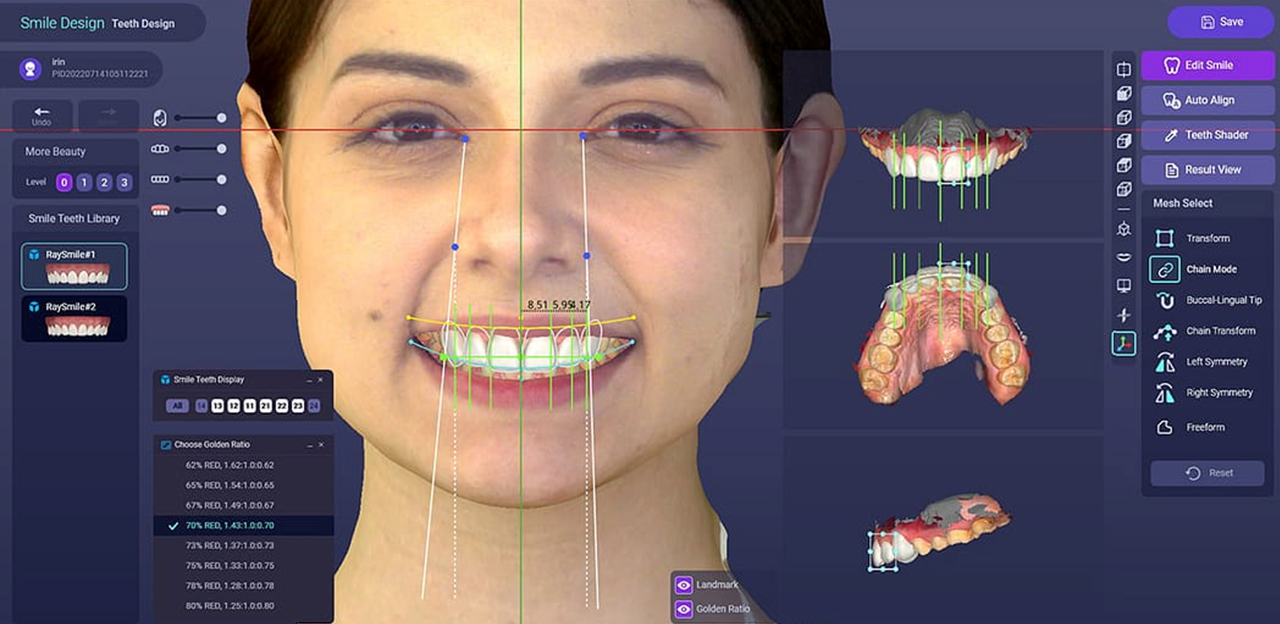
Digital Smile Design (DSD) plays a pivotal role in smile makeovers involving dental veneers, offering precise planning and visualization to achieve optimal aesthetic outcomes. Digital Smile Design is a modern dental planning technique that combines photography, software, and artistic vision to plan your smile makeover with extreme precision. Instead of relying only on a dentist’s imagination or traditional wax models, DSD uses digital tools to create a virtual mock-up of your teeth and smile. By taking detailed images and scans of your face and teeth, the dentist can design your ideal smile on a computer screen – adjusting the shape, size, and alignment of teeth until it looks just right making it more tangible and predictable.
This digital plan isn’t just for the dentist’s benefit – it’s highly visual and collaborative. You get to see exactly how your new smile could appear from different angles, and even give feedback. The primary goal is to enhance communication, accuracy, and predictability in cosmetic dentistry. Here’s how DSD enhances the process of smile makeovers with dental veneers:
Initial Assessment and Analysis:
- Facial and Dental Evaluation:
- Dentists use DSD to analyze the patient's facial proportions, smile dynamics, and dental characteristics.
- Digital photographs and scans capture detailed images of the patient's face and teeth, aiding in comprehensive assessment.
- Smile Design Planning:
- Using specialized DSD software, dentists create a virtual mock-up of the patient's smile. At NOVORIS we use DSD and DTS another AI integrate software to generate the virtual mock-up which makes it even more accurate and allows you to see before the treatment its outcome.
- They manipulate digital images to simulate potential outcomes, adjusting parameters such as tooth size, shape, alignment, and color to achieve harmonious facial aesthetics.

Customized Treatment Planning:
- Patient-Centered Approach:
- DSD allows for collaborative decision-making, where patients actively participate in designing their ideal smile.
- Patients can visualize and provide feedback on the proposed smile design before any treatment begins.
- Simulation of Veneer Placement:
- Dentists simulate the placement of dental veneers on digital models of the patient's teeth.
- This simulation helps in determining the number of veneers needed, their optimal placement, and the expected final appearance.

Implementation and Execution:
- Precise Fabrication of Veneers:
- Based on the approved digital mock-up, precise specifications for dental veneers are sent to a dental laboratory.
- Advanced CAD/CAM technology may be used to fabricate custom veneers that match the planned design accurately.
- Temporary Mock-Up:
- Before fabricating the final veneers, a temporary mock-up can be created using DSD.
- This temporary mock-up allows patients to see and feel their new smile temporarily, ensuring alignment with their expectations.
Treatment Execution:
- Minimized Chair Time:
- With DSD, the treatment process is streamlined and efficient.
- Detailed planning reduces the need for adjustments during veneer placement, potentially reducing chair time and enhancing patient comfort.
- Outcome Prediction:
- Dentists and patients have a clear understanding of the expected outcome before starting the actual treatment.
- Predictability in results contributes to patient satisfaction and confidence in the treatment process.

Post-Treatment Evaluation and Adjustments:
- Final Adjustments:
- After veneers are bonded to the teeth, final adjustments may be made to ensure optimal fit, comfort, and aesthetics.
- DSD facilitates precise adjustments based on initial simulations and patient feedback.
- Long-Term Care:
- Patients receive guidance on post-treatment care and maintenance to preserve the longevity and aesthetics of their new smile.
- Regular follow-up appointments monitor the health and stability of the veneers over time.

Benefits of Using DSD in Smile Makeovers with Veneers:
- Enhanced Precision: DSD ensures meticulous planning and execution, minimizing errors and enhancing treatment accuracy.
- Patient Involvement: Patients actively participate in designing their smile, fostering a collaborative approach to treatment.
- Visual Communication: Clear visualizations help patients understand the treatment process and visualize their future smile.
- Improved Outcomes: Predictable results contribute to high patient satisfaction and confidence in the aesthetic transformation achieved with dental veneers.

Conclusion:
Digital Smile Design revolutionizes smile makeovers involving dental veneers by combining advanced technology with artistic principles. By leveraging DSD, dentists can deliver personalized and aesthetically pleasing results that meet patient expectations. For individuals considering smile enhancement through veneers, exploring DSD with a qualified cosmetic dentist can ensure a customized treatment plan and a transformed smile that enhances both appearance and self-confidence.